

Table of Contents
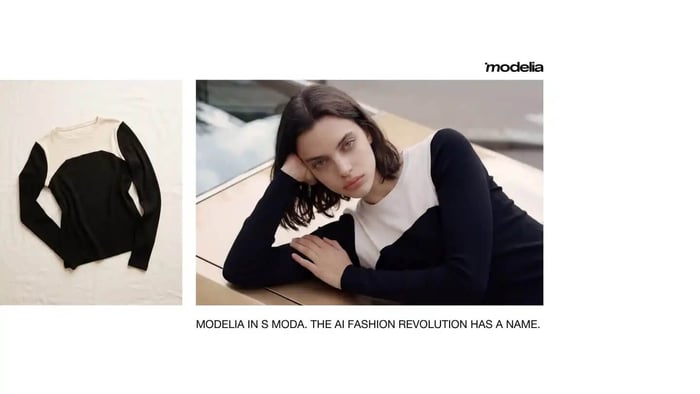
Iván Rodríguez, CEO of Modelia, said it plainly in his interview with S Moda, the fashion supplement of El País, published this week: "Two years ago you could detect that an image was artificial. Today you can't."
One sentence. But what it contains is the entire argument about where fashion imagery is going, and why the conversation the industry has been having about AI for the past three years just changed register.
The S Moda interview is not a product feature. It is a wide-ranging conversation about creativity, authorship, the economics of visual production, the future of human work in fashion, and what happens when technology crosses the threshold from interesting to indistinguishable.

The Threshold Has Been Crossed. What Now?
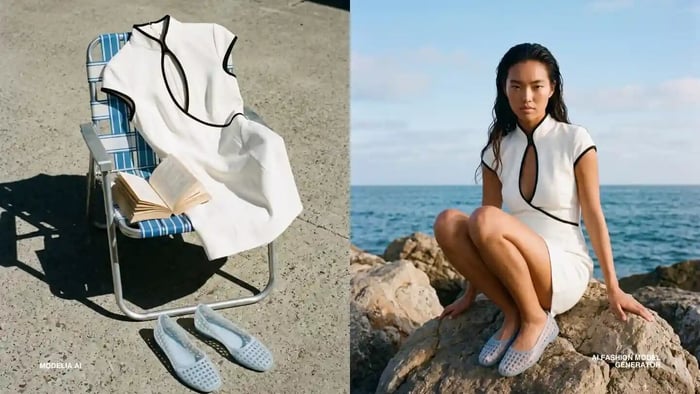
The proof point in the interview is a human one. A photography director at a major luxury house reviewed a collection featuring both conventional and AI-generated images and could not tell them apart.
That story matters because of who is doing the looking. A photography director is precisely the kind of trained professional whose entire career has been built on visual judgment, on seeing what others miss, on distinguishing craft from imitation, on protecting a brand's visual identity at the highest level. If that person cannot reliably identify AI-generated imagery in a real production context, the debate about whether the technology is "good enough" is over.
These are the questions that luxury houses, creative directors, photographers, and stylists are actually working through right now. The S Moda interview puts them on the table for a general audience, and that is why the conversation has moved.
"AI Only Replaces People Who Want to Be Replaced"
"AI only replaces people who want to be replaced. Not everyone." It is worth resisting the temptation to read it as reassurance, because that is not what it is. It is a precise observation about the structure of creative work, about where human judgment is genuinely irreplaceable and where it has already been displaced by process.
Consider what a fashion shoot actually involves. There is a creative vision: a director of art or photography who decides what the image should feel like, what it should say about the garment and the brand, how light and space and body should relate. And then there is the execution of that vision: the logistics of getting the right people in the right place with the right clothes at the right time, the physical process of moving between setups, the production machinery that translates a briefing into a finished image.
AI compresses the execution layer. It does not remove the vision. The stylist who defined the look is still defining the look, but earlier in the process, at the concept stage, where the decisions have always mattered most. The photographer who directed the light is still making compositional and aesthetic judgments, but those judgments now inform a generative output rather than a physical shoot. The work has moved upstream.
What this means in practice is that the roles most under pressure are not the creative ones. They are the logistical ones; the production management, the scheduling, the physical coordination that was never the most creatively interesting part of making a fashion image, but that consumed an enormous share of the time and budget supposedly allocated to creativity.
The Sustainability Argument Nobody Is Talking About Enough
There is a thread in the broader Modelia conversation, one that connects directly with the discussion in S Moda, that rarely gets the attention it deserves: what AI visual production means for the environmental footprint of fashion imagery.
A conventional fashion shoot is a significant logistical operation. Multiple people flying to a location. Equipment transported. A studio heated and lit for days. Styling samples shipped and returned. Hair and makeup products, catering, accommodation. When you multiply that across the hundreds of shoots a major brand runs per year (editorial, e-commerce, campaign extensions, seasonal refreshes, regional variants…) the accumulated emissions are substantial.
Modelia's own research found that AI-generated fashion visuals produce fewer emissions than equivalent conventional photography. That is not a marginal improvement. It is a structural one. And in an industry that has made sustainability a central public commitment while continuing to produce at an accelerating pace, the gap between stated values and operational reality is exactly where a technology like this lands.
The S Moda interview does not go deep into this, but it sits underneath the whole conversation about what changes when the production machine is rebuilt. The economics shift, the speed changes, and the footprint collapses, not as a side effect but as a direct consequence of moving creation from physical to digital.
"Get on Board or Fall Behind"
"Brands have two options: get on board or fall behind."
That framing is a description of what happens in any industry when a production technology crosses a cost and quality threshold that makes it commercially viable at scale.
The brands that have already integrated AI into their visual production, and we documented this in detail in our piece on how luxury fashion brands are using AI campaigns, are not simply saving money. They are changing the ratio between the time spent on creative decisions and the time spent on production logistics.
They are producing more variants, for more channels, with more flexibility to adapt to market signals. They are testing visual directions that would have been too expensive to test conventionally. And they are doing all of this while the brands that have not yet engaged are still running the calculation on whether the technology is ready.
The McKinsey and Business of Fashion State of Fashion 2026 report puts 35% of fashion executives already using generative AI in image creation and product discovery. Black Friday traffic driven by AI tools grew 805% year on year. These are not projections, they are the current state of the industry.
What "fall behind" means in practice is not dramatic collapse. It is incremental disadvantage: slightly higher production costs, slightly slower iteration cycles, slightly less flexibility in how visual content is deployed. Over time, those slight disadvantages compound. The brands that solve the AI integration question in 2026 are building workflows and institutional knowledge that their competitors will have to catch up to in 2027 and 2028, when the tools will be better and the stakes higher.
The Question of Transparency
One thing the S Moda interview touches on that deserves more space than a single interview can give it: the question of disclosure.
When a brand publishes a campaign image, should audiences know whether it was generated by AI? When a model's likeness is used in a generated image, what consent and compensation frameworks apply? When a luxury house labels an AI-generated campaign as such as Gucci did with "Primavera," as Valentino did with its DeVain video, does that labelling protect the brand, or does it create new questions about the relationship between AI output and the craftsmanship the brand has built its value on?
There are no settled answers here. The industry is making them up as it goes, and the decisions being made now (about what to disclose, to whom, in what format) will shape the consumer's relationship with AI-generated fashion imagery for years.
The brands that get ahead of that shift, that build transparency into their approach as a value rather than a compliance obligation, are likely to be better positioned than the ones that treat disclosure as a risk to manage.
Fashion Imagery Is Becoming Infrastructure
There is a word that has been used in several contexts to describe where AI sits in fashion operations now, and it is the right word: infrastructure.
Not a tool. Not a feature. Infrastructure; the underlying system that everything else runs on.
The shift from tool to infrastructure is a specific kind of change. A tool is something you pick up for a particular task and put down when the task is done. Infrastructure is what you build on. It shapes what is possible, what is fast, what is cheap, what is hard. When photography became the infrastructure for fashion imagery in the twentieth century, it did not just change how campaigns were made. It changed what a campaign was, what a model was, what a fashion brand's visual identity meant.
AI is making the same kind of move. The brands that understand this, that are building their creative and production processes around AI as infrastructure rather than experimenting with it as a tool, are making a different kind of commitment than the ones still treating it as optional.


